Showing posts with label chinatown. Show all posts

Sunday, August 21, 2011

Chung King Road...Gremlins Anyone?

I took a little detour from the "main" drag of Chinatown to check out Chung King Road...here is what I learned...

Chung King Road is a pedestrian street in the northeast corner of Chinatown, Los Angeles. This street is a part of "New Chinatown," built in the 1930s and 1940s, and is the location of Chinese specialty shops and art importers. In the late 1990s many of the storefronts were sitting unused, and several of them were converted into art galleries. As part of an overall gentrification of the area, Chung King Road is now one of the centers of art and nightlife in Downtown Los Angeles.


Apprently, during the day, the little alley of Chung King Road, Los Angeles — only some 40 feet wide — is bare and quiet.


The occasional lone straggler might make his way through the alley, a shortcut to get to Chinatown’s main attractions. But on art opening nights, which occur on Saturdays every few weeks, throngs of LA art enthusiasts come to check out the latest in a new wave of galleries settling into Chung King Road’s less-than-shiny streetscape.


I agree with what I read...It’s a strange and somewhat romantic scene, with the alley’s lanterns and worn-out gallery facades, as if pulled from some derelict 1950s movie set.


I totally think Gizmo was bought in one of these shops too...just sayin...


Yet, it’s a scene that has become a new center for art in Los Angeles. Some describe it as a displaced Westside arts district — hip, edgy and young. And while the art is breaking boundaries, the galleries are still paying tribute to the culture of Chinatown; many have kept the original storefront names. Check out some of the galleries anchoring the growing art scene in Chinatown.


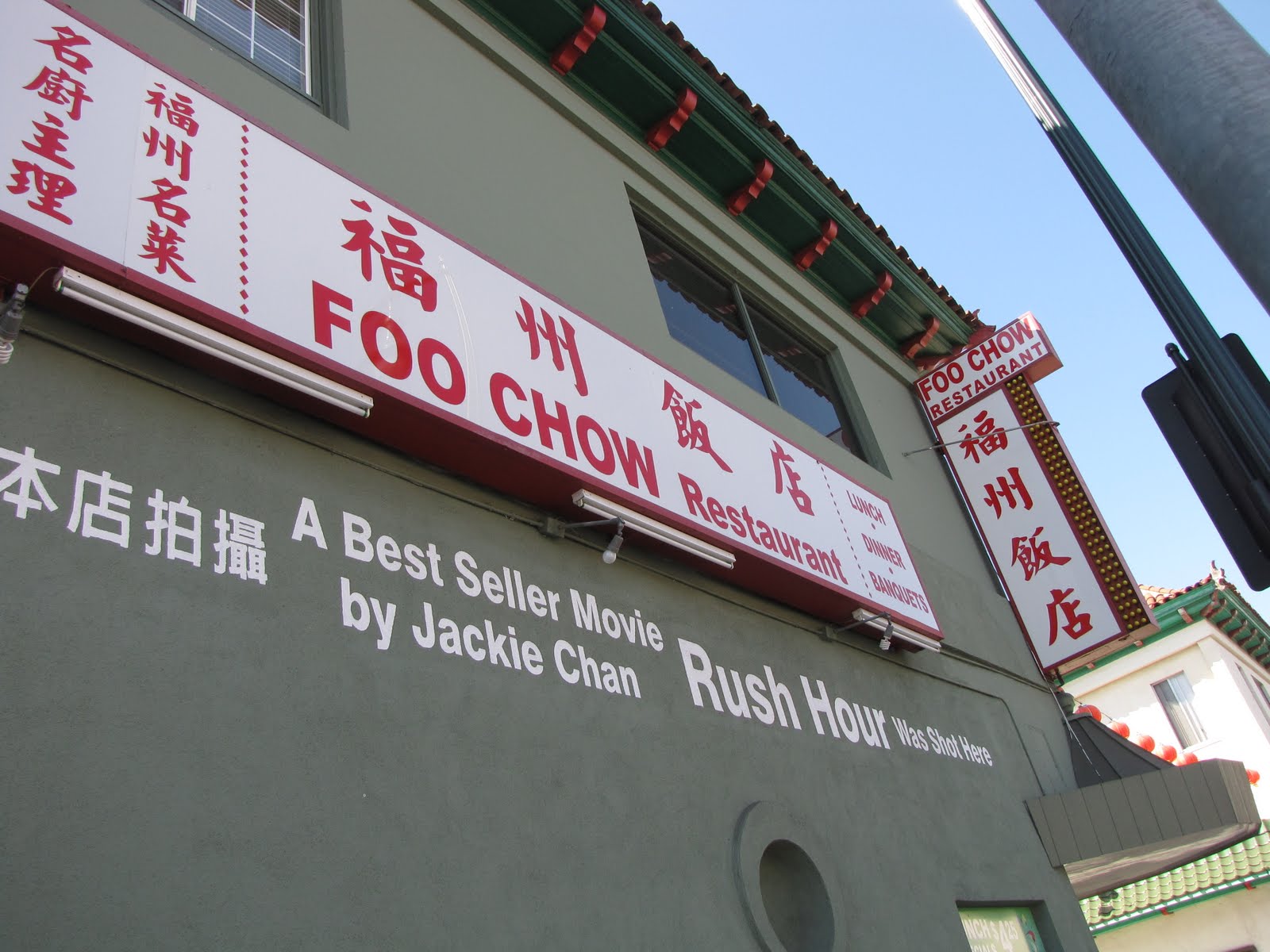
The best part may just be Foo Chow, the restaurant not only known for great food, but also where scenes from the movie Rush Hour were shot...


Do you have any interesting film locations in your town?

Friday, August 19, 2011

Chinatown History and a War Veteran

As I played tourist in Chinatown...I was happy to see an "Open" sign at the Chinese Historical Society of Southern California...here is what I learned and who I met...

Since the 1850s, Chinese Americans have contributed to the historical growth and development of Southern California's life and culture.

The Chinese Historical Society of Southern
California (CHSSC) was organized November 1, 1975 and incorporated in the State of California in 1976 (they year I happened to be born - go Dragons!)

The Chinese Historical Society of Southern California was established to discover and recognize Chinese pioneers and their history. They strive to increase awareness of Chinese American heritage through public programs, education and research...good stuff!


They offer a variety of educational and fun activities through monthly program meetings, which are free and open to all. They work with colleges, universities, other historical societies and local community groups.

The support of individuals and businesses through tax-deductible donations, memberships and volunteering is crucial to our plans to develop a Chinese Cultural Heritage Center.


Ben Fong was born in Sacramento in 1921 and moved with his family to the East Adams District a decade later. After the bombing of Pearl Harbor, Ben decided to join the United States Marine Corps but was refused due to the color of the skin. Ben was later drafted in the Army and stubborn and persistent as he was, became a Military Intelligence expert. For Fong, as well as for many other Chinese Americans, the war was indispensable in solidifying the inclusion of Chinese into the larger American narrative.


Now retired, Ben Fong has moved back to Chinatown after getting tired of driving back and forth from the San Gabriel Valley to visit the newly opened Chinatown Public Library, which hosts one of the largest collections of books in Chinese in the country.

Among the many interesting things I learned, Ben shared this timeline with me, letting me know Chinese came over on Spanish ships back when LA was just discovered...

1769
Spanish explorers under Gaspar de Portola enter the area that is now Los Angeles on their way northward.

1781
El Pueblo de la Reina de Los Angeles is founded by Felipe Neve.

1848
The discovery of gold at Sutter's Mill starts the California gold rush. This brings many people from all over the world including Chinese.

1850
On September 9, California gains statehood. The first U.S. Census taken after California's admission into the union shows 2 Chinese house servants listed as residents of Los Angeles: Ah Fou and Ah Luce.

1854
California Supreme Court includes Chinese among racial classes prohibited from testifying against whites.

1859
Arrival of first Chinese woman to the United States. Chinese fishermen become established off Catalina Island.


Is there a Chinatown where you live?

Monday, August 15, 2011

Fortune Telling...Chinatown Style

What can I say...I'm intrigued by fortune telling, psychics, tarot cards...yes, mostly for entertainment, as I'm a natural skeptic. So for $10 (ok, it was $20)...how could I refuse an authentic Chinese Fortune Telling while I was in Chinatown...


First, a little background on this art...

Chinese fortune telling, better known as Suan ming (Chinese: 算命, literally "fate calculating") has utilized many varying divination techniques throughout the dynastic periods. There are many methods still in practice in China, Taiwan and Hong Kong today, and they remain in use due to their accuracy and popularity. Over time, some of these concepts have moved into Korean, Japanese, and Vietnamese culture under other names. For example "Saju" in Korea is the same as the Chinese four pillar method.


Now for the good stuff...what did I learn about my future from this seemingly harmless, hard to understand 100 year old Chinese man?


Well, he looked at my palm and face with a magnified glass and scribbles on this sheet of paper...


Honestly, I couldn't understand most of what he was saying, but I did get what marked on the paper. He laughed and mumbled a lot....here is the gist of what I learned:

- 2011 and 2012 are not good years for me (boo)

- 2013 and 2014 is where things will take off for me, in finance and romance

- I will marry in 2013 to someone between the ages of 25-30 (hmmmm)

- I will have 2-5 kids and must start by 2016 or 2017 (no pressure)

- My best months for luck are May, June, July, August and November (at least this year)

- I am a Dragon - Honest, sensitive, and brave.

- I match well with the following Chinese horoscopes: Rat, Monkey, Rooster (I must stay away from Dog, Cow, Rabbit and Dragon)

- South and East locations are best for me (to live in or buy property) - he said I would do well to buy property in China or India, not in America or Mexico

- Summer is the best season for me, Fall is OK...Spring and Winter are no good

- My lifeline goes until about 90 years of age

- My best years will be when I'm 41-50 years old

- Good elements for me are: Soil, Gold and Fire

- Bad elements for me are: Water and Wood (which I like both of, so I was bummed)

What does all this mean? Who knows, it was 10 minutes of entertainment. Am I changing my life and hunting for someone born in the year of the Monkey, Rat or Rooster? No, not yet...I have until 2013...ha!

Have you ever had your fortune read? Tell me about it...

Sunday, August 14, 2011

Playing Tourist in LA's Chinatown


What can I say...I used to "cut through" Chinatown on my commute to work everyday for almost a year. I ate there once back in 2002. Have I ever really explored it? Not until today. I'm glad I did. I had fun taking pictures and learning (basically, playing tourist).

Join me on a self-guided tour....with the help of the Interweb...

As early as 1852, a Chinese settlement was recorded near the site of today's Union Station. The community resettled some 86 years later a few streets over, and in 1938, with the dedication of Central Plaza, became the first modern American Chinatown, owned and planned from the ground up by Chinese.


Start your visit at Central Plaza (947 N. Broadway) where you will be enchanted by the quaint walkways and tiny shops. The sound of clicking mahjong tiles can be heard from upstairs windows where many of Chinatown's family associations hold their social meetings. A popular place for filming, Central Plaza with its distinctive "Gate of Filial Piety" also boasts a statue of Dr. Sun Yat Sen, founder of the Republic of China, a wishing well dating to 1939, and a five-tiered pagoda. On the building at 951 N. Broadway, you will find a dragon painted by Tyrus Wong.


A step outside and to the left of Central Plaza brings you to the doorstep of Phoenix Bakery (969 N. Broadway, 213/628-4642). This is the oldest and largest bakery in Chinatown with a citywide reputation for its strawberry whipped cream cakes.


Turn back and walk south along North Broadway. As you pass the curio shops and jewelry stores, stop to take in the beautiful tile murals on the wall at 913 North Broadway. Across the street, note Little Joe's Restaurant, a reminder of the large Italian population that also once lived here. The restaurant has recently been purchased and plans are under way to develop the site and restore the restaurant.


Continuing south, on the left side of the street are Saigon Plaza (a hot mess that felt very much like Bangkok), Chinatown Plaza and Dynasty Center (800 block of North Broadway). Most of the shops and stalls in these bazaars are owned by Chinatown's newest ethnic Chinese immigrants from Vietnam, Cambodia, and Laos.


These bazaars offer real bargains on clothing, toys, food and knickknacks of all kinds. As you walk on the west side of the street your eyes will be caught by a number of jewelry stores sparkling with 18K and 22K gold and exquisite jade creations.


Pit stop for lunch at Hop Louie ...not bad...with $5 lunch specials and an "A" rating...score...


Of course in true LA fashion, lots of celebrities have dined here...


On the corner of Alpine and Broadway is Cathay Bank (777 N. Broadway), the first Chinese American-owned bank in Chinatown. Also on this block is Far East Plaza, considered the first modern ethnic shopping mall in America. Originally a retail plaza exclusively for food, Far East Plaza still houses several restaurants serving styles of regional cuisine that can be found here and nowhere else in Chinatown. It is home to Wing Hop Fung Ginseng and China Products Center (727 N. Broadway, 213/626-7200), the largest store of its kind in Los Angeles, fragrant with herbs and tea, and overflowing with chinaware, garments, arts and crafts. A pharmacy and acupuncturist are located within.


A little detour will take you into another world: an incense-filled Taoist Temple (750 Yale Street). This ornately decorated temple serves as a focal point of the immigrant community and is one of the most beautiful of its kind. As with any religious institution, please be respectful of worshippers and staff on the premises.

By walking or driving back north along Hill Street you will pass the Chinese United Methodist Church (825 Hill Street) which exemplifies a unique blending of Chinese and American architecture dating to the 1940s. The Pacific Alliance Medical Center (931 Hill Street) at the corner of Hill and College streets is one of the first hospitals in Los Angeles. It was built in 1868 to serve the city's French population nearby and boasts a statue of Joan of Arc on the front lawn. Today, the hospital is run by enterprising Chinese doctors and serves the local Chinatown community.


A little further down Hill Street is West Plaza, built in the late 1940s, and mentioned in Lisa See's novel "On Golden Mountain." The F. See On shop at the corner of the courtyard is actually run by See family members. West Plaza houses businesses on the ground floor and residences upstairs. The plaza is also home to a burgeoning new art community whose avant-garde galleries are interspersed among the curio shops.


At the end of North Hill Street, turn right on Bernard Street where you will find the headquarters of the Chinese Historical Society of Southern California (411 and 415 Bernard Street). Both houses were built in the late 1880s by French immigrants. The visitor center showcases artifacts and historical photos recounting the history of the Chinese in Southern California. Call 323/222-1918 for information and Visitor Center hours.


As always...I urge you to get out there and explore the city, town or village you live in!

(Stay tuned for future posts on Chinese fortune telling, Chung King Road and a visit to the Chinese American Historical Society - you know you can't wait)